

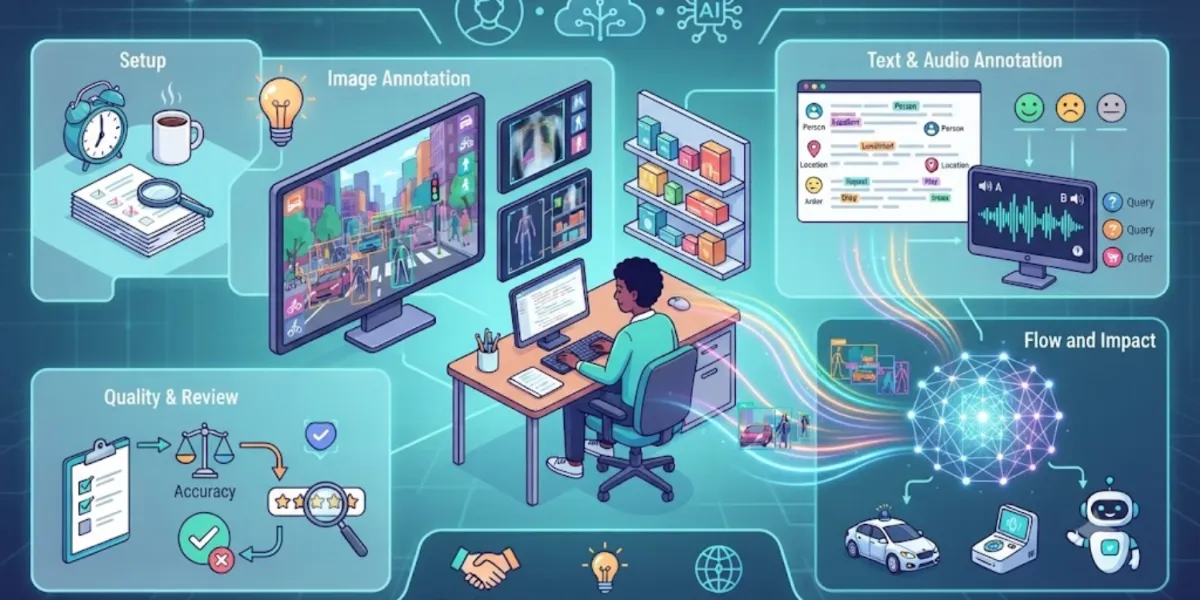
Contributors on DataAnnotation evaluate AI-generated content, rank model outputs, review code for errors, write and assess prompts, check factual accuracy, and test AI-generated images. The work varies by project and discipline, but it always comes down to applied judgment rather than technical pipeline work.
What the Work Actually Looks Like
You are not building algorithms or managing data pipelines. The role is closer to applied evaluation: reading an AI response to a complex question, identifying where it succeeds or falls short, and documenting your reasoning clearly.
No prior AI industry experience is required. What matters is domain knowledge and analytical judgment.
Projects span five broad tracks. General work covers evaluating chatbot responses, comparing AI outputs, and testing image generation. Coding work covers reviewing AI-generated code, debugging outputs, and building training datasets. STEM work covers domain evaluation in mathematics, physics, chemistry, and biology. Professional work covers assessing accuracy in law, finance, and medicine. Multilingual work covers translation, localization, and cross-language evaluation.
A single well-reasoned annotation can influence how a model handles similar cases across millions of future interactions.
The Role Human Feedback Plays in AI Development
AI models improve through sustained exposure to high-quality human evaluation. When a contributor identifies a flawed reasoning chain, flags a misapplied legal standard, or notes that a mathematical proof contains an error, that correction becomes part of how the model learns.
The work is not hypothetical. Models trained through this process are deployed at scale, used by researchers, professionals, and students across industries. A single well-reasoned annotation can influence how a model handles similar cases across millions of future interactions.
This is what distinguishes DataAnnotation contributors from commodity annotation workers: the platform is designed to extract genuine expertise. Projects are matched to contributors based on skill level, and quality of work determines access to more projects over time.
Skills and Backgrounds That Qualify
The General track asks for a bachelor's degree or equivalent real-world experience, with strong writing and critical thinking skills. No technical background is required. The Multilingual track asks for native fluency in one or more languages beyond English. The Coding track asks for programming experience in languages such as Python, JavaScript, HTML, C++, C#, or SQL. The STEM track asks for an advanced degree (master's or PhD) in mathematics, physics, biology, or chemistry, or a bachelor's degree combined with 10+ years of professional experience. The Professional track asks for licensed credentials in law, finance, or medicine.